28 February, 2007

[CFP] CAE2007 Computational Aesthetics [DL] 5th March, 2007

http://innovis.cpsc.ucalgary.ca/cae2007

Our ability to convey complex meaning and emotion by the clever arrangement
of symbols and signs is one of the most celebrated aspects of our human
heritage. If Aesthetics is defined as the interaction between symbol and
observer within a social context, then Computational Aesthetics is the
empirically based field that examines applications of Aesthetics.
Computational Aesthetics integrates aspects of computer science, psychology,
and the visual arts, with particular focus on the mathematical and
information theoretic aspects of symbol processing by humans and computers.
By combining insights from these fields, Computational Aesthetics not only
provides tools for the graphics and visualization communities to increase
the value of displayed imagery and to avoid classical artifacts, but also
furthers our understanding of perception and meaning. Computer based tools,
resulting from Computational Aesthetics research, may also be used to
enhance the expressive power of the fine and applied arts and to expand the
role of aesthetic design as a differentiating factor in product development
and retail sales.
We are pleased to announce the third workshop on Computational Aesthetics,
which will take place in Banff, Alberta, Canada. This conference will bring
together individuals with technical backgrounds who are developing computer
based tools to solve aesthetic problems and people with artistic and design
backgrounds who use these new tools in their work. Invited talks will be
given by leading technical and artistic/design figures to help participants
to better understand what computer technology is capable of delivering and
to fully appreciate what is involved in the artistic and design process.
Refereed papers will also be presented to provide a snapshot of the latest
technical breakthroughs and the most recent artistic or design achievements
in applying computer based techniques to solve aesthetic problems. The
overriding goal of the conference will be to facilitate a dialogue between
the scientists and engineers who are creating these new tools and the
artists and designers who are the end users.

Submissions are invited across the broad range of areas covered by
Computational Aesthetics. Specific examples include, but are not limited to:

a.. Artistic Image Transformation Techniques (colors, edges, patterns,
dithering)
b.. Image Analogies, Style Transfer Methods
c.. Sketching, Simplification techniques (artistic, cognitive)
d.. Composition, Visual Balance, Layout
e.. Non-Photorealistic Rendering
f.. Image Style Analysis (Paintings, Photographs, others)
g.. Empirically based Metrics of Aesthetical Attributes
h.. Applied Visual Perception (Color Appearance, Spatial Vision, and other
aspects)
Submitted papers should be original, unpublished work of up to 8 pages. The
manuscripts must be written in English. For details on the submission
guidelines please refer to the paper submission page. Best papers will be
encouraged to submit a journal version to a special issue of IEEE CG&A.

Note that this call for technical contributions is complemented by a call
for participation by experts in the visual arts.

Download this call for papers as a TXT file or a PDF file.

12 February, 2007

[CFP] WORLDCOMP'07, The 2007 World Congress in Computer Science, Computer Engineering, and Applied Computing.

Last Call For Papers
The 2007 World Congress in Computer Science,
Computer Engineering, and Applied Computing
WORLDCOMP'07
Date and Location: June 25-28, 2007, Las Vegas, USA
Academic Sponsors: Research Labs at
MIT, Harvard, Purdue, Univ. of Texas at Austin, ...
Paper Submission Deadline: February 20, 2007
url: http://www.worldacademyofscience.org/worldcomp07

You are invited to submit a full paper for consideration.
All accepted papers will be published in the conference proceedings.
The 2007 World Congress in Computer Science, Computer Engineering,
and Applied Computing (WORLDCOMP'07) is composed of the following
research and technical tracks (all will be held simultaneously,
same location and dates: June 25-28, 2007, USA):
o Parallel and Distributed Processing Techniques and Applications
(PDPTA'07)
o Grid Computing and Applications (GCA'07)
o Computer Design (CDES'07)
o Scientific Computing (CSC'07)
o Artificial Intelligence (ICAI'07)
o Genetic and Evolutionary Methods (GEM'07)
o Machine Learning; Models, Technologies and Applications
(MLMTA'07)
o Bioinformatics and Computational Biology (BIOCOMP'07)
o Software Engineering Research and Practice (SERP'07)
o Wireless Networks (ICWN'07)
o Image Processing, Computer Vision, and Pattern Recognition
(IPCV'07)
o Modeling, Simulation and Visualization Methods (MSV'07)
o Computer Graphics and Virtual Reality (CGVR'07)
o Multimedia Systems and Applications (MSA'07)
o Internet Computing (ICOMP'07)
o Semantic Web and Web Services (SWWS'07)
o Security and Management (SAM'07)
o Data Mining (DMIN'07)
o Information and Knowledge Engineering (IKE'07)
o e-Learning, e-Business, Enterprise Information Systems, and
e-Government (EEE'07)
o Embedded Systems and Applications (ESA'07)
o Frontiers in Education: Computer Science and Computer Engineering
(FECS'07)
o Foundations of Computer Science (FCS'07)
o Engineering of Reconfigurable Systems and Algorithms (ERSA'07)
o Communications in Computing (CIC'7)
(a link to each of the above can be found at
http://www.worldacademyofscience.org/worldcomp07/ws )
Submission of Papers:
Prospective authors are invited to submit their full paper
(about 5 to 8 pages - single space, font size of 10 to 12) to
H. R. Arabnia by Feb. 20, 2007 (hra at cs.uga.edu). E-mail submissions
in MS Doc or PDF formats are preferable (postal mail submissions
are also fine.) All reasonable typesetting formats are acceptable
(later, the authors of accepted papers will be asked to follow a
particular typesetting format to prepare their papers for publication.)
The length of the Camera-Ready papers (if accepted) will be limited to
7 (IEEE style) pages. Papers must not have been previously published
or currently submitted for publication elsewhere. The first page of
the draft paper should include: title of the paper, name, affiliation,
postal address, email address, and telephone number for each author.
The first page should also identify the name of the author who will
be presenting the paper (if accepted) and a maximum of 5 topical
keywords that would best represent the content of the paper. Finally,
the name of the conference/track that the paper is being submitted to
must be stated on the first page.
Each paper will be refereed by two experts in the field who are
independent of the conference program committee. The referees'
evaluations will then be reviewed by two members of the program
committee who will recommend a decision to the chair of the track that
the paper has been submitted to. The track chair will make the final
decision. Lastly, the Camera-Ready papers will be reviewed by one
member of the program committee.
Members of Program and Organizing Committees:
The Program Committee includes members of chapters of World Academy
of Science (chapters: supercomputing; scientific computing; artificial
intelligence; imaging science; databases; simulation; software
engineering; embedded systems; internet and web technologies;
communications; computer security; and bioinformatics.) Many members
of the program committee for individual conferences include renowned
leaders, scholars, researchers, scientists and practitioners of the
highest ranks; many are directors of large research laboratories,
IEEE Fellows, heads/chairs of departments, deans and provosts.
Each committee also includes two Student Members (in their final stages
of their PhD programs) who are identified as such. Refer to the
conference web sites for the list of members of program committee.
Co-Sponsors (a partial list):
Academic Co-Sponsors of WORLDCOMP'07 include:
- Massachusetts Institute of Technology (MIT) Media Laboratory,
MIT (Cambridge, Massachusetts)
- Statistical Genomics and Computational Biology Laboratory,
Department of Statistics, Harvard University (Cambridge,
Massachusetts)
- Texas Advanced Computing Center, The University of Texas at
Austin (Austin, Texas)
- Statistical and Computational Intelligence Laboratory of
Purdue University (West Lafayette, Indiana)
- University of Iowa's Medical Imaging HPC Lab (Iowa City, Iowa)
- Institute for Informatics Problems of the Russian Academy of
Sciences, Moscow, Russia);
Other Co-sponsors include:
- HPCwire
- GRIDtoday
- STEM Education Society
- HPCSoft, HPC Software Inc.
- International Technology Institute
- H2cM - Hodges' Health, UK
Purpose / History:
This set of joint conferences is the largest annual gathering of
researchers in computer science, computer engineering and applied
computing. Many of the 25 joint conferences in WORLDCOMP are the
premier conferences for presentation of advances in their respective
fields. We anticipate to have 2000 or more attendees from over 75
countries participating in the 2007 event.
The motivation is to assemble a spectrum of affiliated research
conferences into a coordinated research meeting held in a common
place at a common time. The main goal is to provide a forum for
exchange of ideas in a number of research areas that interact. The
model used to form these annual conferences facilitates communication
among researchers from all over the world in different fields of
computer science, computer engineering and applied computing. Both
inward research (core areas of computer science and engineering) and
outward research (multi-disciplinary, inter-disciplinary, and
applications) will be covered during the conferences.
Important Dates:
Feb. 20, 2007: Submission of full papers (about 5 to 8 pages)
March 20, 2007: Notification of acceptance
April 20, 2007: Camera-Ready papers and Registration due
June 25-28, 2007: The 2007 World Congress in Computer Science,
Computer Engineering, and Applied Computing
(WORLDCOMP'07)


----

Akihiko Shirai, Ph.D
Invited Researcher
Presence & Innovation Laboratory ENSAM France
http://akihiko.shirai.as/

05 February, 2007

[CFP] Prix Ars Electronica 2007 - Call for Entries

Dear friends and participants of Prix Ars Electronica!

The 21st Prix Ars Electronica 2007 - International Competition for Cyberarts has a few new features.

The new Hybrid Art category, a new prize for Media.Art.Research, and the integration of Net Vision into Digital Communities are the most visible signs of the intensive work that is being done on the definition of the competition's categories. As always, the aim is to continually keep the Prix Ars Electronica updated in line with leading-edge developments in the dynamic field of cyberarts.

Prix Ars Electronica 2007
Online Submission Deadline: March 9, 2007

Computeranimation / Film / VFX, Digital Musics, Interactive Art, Hybrid Art,
Digital Communities, u19 - freestyle competition, [the next idea] grant,
Media.Art.Research Award

All details about the categories and the online submission
are available online only at: <http://prixars.aec.at>

Total prize money: 122.500 Euro

Please feel free to forward this to all interesting/ed parties.

best regards
Iris

Contact: Iris Mayr
Project Manager Prix Ars Electronica

AEC Ars Electronica Center Linz
Museumsgesellschaft mbH
Hauptstra゜e 2
A-4040 Linz
Tel. ++43.732.7272-74
Fax ++43.732.7272-674
info at prixars.aec.at
http://prixars.aec.at

If this e-mail has been sent to you by mistake or if you'd like to have your name removed from our mailing list, please send an e-mail with the word UNSUBSCRIBE in the subject line to the following address: info at prixars.aec.at


Akihiko Shirai, Ph.D
Invited Researcher
Presence & Innovation Laboratory ENSAM France
http://akihiko.shirai.as/

[CFP] Interaction Design and Children conference,5-6 June 2007, Denmark

Call for papers for the Interaction Design and Children (IDC 2007) conference, 6-8 June, 2007, Aalborg, Denmark

(http://idc2007.cs.aau.dk/index.html)

Keynote speakers at the IDC conference will be:

Professor Mitchel Resnick, MIT Media Laboratory, Cambridge, Massachusetts, USA Mark William Hansen, Director of Business Development, Lego, Billund, Denmark

The increased focus on children’s role in the design and evaluation of interactive technologies has provided several interesting research studies and results. Currently, we are aware of the fact that children have been characterized as not just young adults, but as independent individuals with their own strong opinions, needs, likes, and dislikes, and they should be treated as such. Several studies have focused on children in educational or training settings; this has been natural as children often encounter and use information technology in schools. Thus, children have often participated as future end-users of educational or edutainment technologies.

IDC 2007 welcomes submissions on all topics from the domain of interaction design and children, including, but not limited to:

* Usability, enjoyability, accessibility, persuasion, ethics, and safety issues, with particular reference to children

* Evaluation methods for use with children

* Evaluations of interactive systems and technologies for children

* Emerging or new technologies and their impact on children's health, education or play

* Methods and techniques for establishing children's requirements for interactive systems

* Guidelines for the design of interactive systems for children

* Reports on the development of interactive systems for children (motivation, design, outcome, evaluation)

* Design of innovative systems to children

* Theoretical models of interaction with special relevance to children

* Results of ethnographic and case studies in children's use of interactive systems

* Stimulating in-depth analyses of issues related to interaction design and children

* Effects of interactive technologies in children's lives (e.g. game violence and aggression, obesity, learning)

* Design and evaluation of interactive systems for children with special needs

Submission deadlines:

Full papers: January 19, 2007

Short papers: March 5, 2007

Poster and demos: March 5, 2007

Notification deadlines:

Full papers: February 23, 2007

Short papers: March 30, 2007

Poster and demos: March 30, 2007

Camera-ready deadlines:

Full papers: March 16, 2007

Short papers: April 10, 2007

Poster and demos: April 10, 2007

To address emerging research and development, IDC 2007 will look for papers, demonstrations, posters that may include at least one of the following broad areas:

* Emerging technologies for children (e.g., innovative educational simulations, online games, accessible fabrication devices, mobile communications devices, wireless embedded technologies, sensors and actuators, "smart" materials, authoring/programming tools)

* The impact these technologies can have on children's lives (e.g., in schools, at home, in public spaces)

* New research methods which give children a voice in the design, development, and evaluation processes (e.g., participatory design methods, usability testing, etc.)

All accepted papers are presented at the IDC 2007 conference, and appear in the IDC 2007 Proceedings. Proceedings will be published in the ACM Digital Library.

For more information please check the IDC 2007 website:

http://idc2007.cs.aau.dk/index.html


Akihiko Shirai, Ph.D
Invited Researcher
Presence & Innovation Laboratory ENSAM France
http://akihiko.shirai.as/

[CFP] Laval Virtual ReVolution 2007

Laval Virtual ReVolution 2007
-World Performance of VR Applications-

Laval Virtual ReVolution is an annual honor to the world’s finest VR project, by Laval Virtual. This is a hall of fame award that decides the best Virtual Reality demonstration and/or application from all over the world. Virtual Reality is not only a technology but also a never ending story between computers and human history.

We cannot get the final answer of this issue immediately, as we still need to find and walk one of the many possible paths that will lead us to a future navigated by brilliant stars. The staring at those stars should be continued for the future voyagers on the way.

Of course, a great number of academic papers or commercial products can build a way of Virtual Reality. However we suggest a new relation between developmental projects and general public at on-site demonstrations. If a performed project has impact, technology and is persuasive, it will move the general public and change the common sense. So, this means a revolution in the history of Virtual Reality.

Please try to join today's stardom with your exciting project.
And share the activity from all over the world!


Session Organizer: Akihiko SHIRAI, Ph.D (ENSAM P&I Lab / JSPS)


Laval Virtual 2007, one of the biggest European Virtual Reality conventions, will be held at 18th-22nd April. A new demonstration session, "ReVolution" was successfully started at last edition. And is it is now open to receive your submissions for 2007.

We hope to accept your brilliant projects which can get over the current common sense of Virtual Reality and make changes to the current human-computer interfaces and Virtual Reality history.

-Technology Demonstration
-Interactive Arts
-Entertainment VR
-New Media Designs
-New Game Systems
-New Human Interfaces and Displays
-Realtime Images
........And any other "non genre" VR projects


[Call for Demo]
Submission Deadline: 31st Jan. 2007 23:59 GMT [Extended]-> 7th Feb. 2007 23:59 GMT
Results will be announced at 20th Feb. 2007.

Please register this website now, then read documents below.
http://www.laval-virtual.org/revolution/

-2nd Call For Demo (International, English & Japanese)
http://www.laval-virtual.org/revolution/2007/doc/CFDemo-LavalVirtualReVolution2007v2.pdf


Akihiko Shirai, Ph.D
Invited Researcher
Presence & Innovation Laboratory ENSAM France
http://akihiko.shirai.as/

22 January, 2007

[auto] A young hero comes to Laval

Today, an internship student comes from the JAIST Miyata lab .
He will be studying abroad for 3 months.


Kendo 4-dan, the face manifique is the egg of the CG researcher who had the atmosphere of feeling not be able to oppose to the toe TASS Matsumoto being similar and name.

With only the liquor, doubtfully - is also a [i] atmosphere simultaneously.
(As for here however perhaps, it is the French direction)
Furthermore although it is overseas travel unprecedented, it is mid-term studying abroad.
Naturally French seems that is close to zero.
It probably is to be able to arrive to Laval safely??
Because this year for the free foreigner French can be audited even fortunately, if only start it is cut off well, those which are obtained are to think that it is large, but….

As my guidance policy,
It goes with physical education meeting affiliation, or goes in the leaving play?…For the present however you do not understand yet, it is young, while with overcoming with venture heart, you think that we want learning various thing.

Well, without involving my life and the family in “venture,” only and should have done however it is,….

Everyone support we ask may with such a reason.


Here is the original article in Japanese.
Today I had generate this post with auto translation by Google.
I think the translation quality is 30%... :-p

Akihiko Shirai, Ph.D
Invited Researcher
Presence & Innovation Laboratory ENSAM France
http://akihiko.shirai.as/

21 January, 2007

Face Input Building Block on Virtools

Finally, I had uploaded my video on YouTube...
http://www.youtube.com/watch?v=ihiNpbrhtxY


Akihiko Shirai, Ph.D
Invited Researcher
Presence & Innovation Laboratory ENSAM France
http://akihiko.shirai.as/

[CFP] WIAMIS 2007-Deadline Extended to Jan.24

WIAMIS 2007, 6-8 June 2007, Santorini, Greece

http://mkg.iti.gr/wiamis2007/


DEADLINE FOR PAPER SUBMISSION EXTENDED TO JANUARY 24


OBJECTIVES


The International Workshop on Image Analysis for Multimedia Interactive Services (WIAMIS) is one of the main international fora for the presentation and discussion of the latest technological advances in interactive multimedia services. The objective of the workshop is to bring together researchers and developers from academia and industry working in all areas of image, video and audio applications, with a special focus on analysis. After Louvain (1997), Berlin (1999), Tampere (2001), London (2003), Lisboa (2004), Montreux (2005), Incheon (2006), WIAMIS 2007 is held in Santorini, Greece.


TOPICS

Topics of interest include, but are not limited to:


Multimedia content analysis and understanding

Content-based browsing, indexing and retrieval of images, video and audio

2D/3D feature extraction

Advanced descriptors and similarity metrics for audio and video

Relevance feedback and learning systems

Segmentation of objects in 2D/3D image sequences

Identification and tracking of regions in scenes

Voice/audio assisted video segmentation

Analysis for coding efficiency and increased error resilience

Analysis and understanding tools for content adaptation

Multimedia content adaptation tools, transcoding and transmoding

Content summarization and personalization strategies

Data hiding and copyright protection of multimedia content

Semantic mapping and ontologies

Multimedia analysis for advanced applications

Multimedia analysis hardware and middleware


INVITED TALKS

WIAMIS 2007 will include in its Technical Program 2 invited talks by leading experts in the field of multimedia processing.

* Shih-Fu Chang, “Recent Advances and Open Issues of Digital Image/Video Search”

* Irfan Essa, “Data-driven and Procedural Analysis and Synthesis of Multimedia”


INDUSTRY SESSION

In addition to Invited Talks, its Regular Technical Program and a number of Special Sessions, WIAMIS 2007 will also include an Industry Session featuring talks by key industry players. Already confirmed industrial representation includes Google, FAST and Deutsche Welle. For more information, please check the related page at the WIAMIS 2007 site.


PAPER SUBMISSION

Paper submission is now open. Prospective contributors are invited to submit extended summaries electronically, using the online submission system at http://mkg.iti.gr/wiamis2007/submission/. Submissions should be in Adobe PDF file format, written in English, following the two-column IEEE conference proceedings format and extending no more than four two-column pages including all figures, tables and references. The proceedings will be published by IEEE and archived to IEEE-Xplore and the IEEE Computer Society digital libraries.


IMPORTANT DATES

Paper Submission: 24 January 2007 (EXTENDED)

Review results: 23 February 2007

Submission of camera-ready papers: 9 March 2007


WIAMIS 2007 ORGANIZING COMMITTEE


General Chairs

* Yiannis Kompatsiaris, Informatics and Telematics Institute, Greece

* Yannis Avrithis, National Technical University of Athens, Greece


Technical Program Chairs

* Milind R. Naphade, IBM T J Watson Research Center, USA

* Noel O'Connor, Centre for Digital Video Processing, Dublin City University, Ireland

* Vasileios Mezaris, Informatics and Telematics Institute, Greece


Special Sessions Chair

* Murat Tekalp, College of Engineering, Koc University, Turkey


Industry Liaisons

* Adrian Matellanes, Motorola Labs, UK

* Nikos Sarris, Athens Technology Center S.A., Greece


CONTACT


For questions, problems and all other inquiries, please contact wiamis2007(at)@iti.gr


----
THIS INFORMATION IS FROM CONFERENCE ORGANIZER
----

Akihiko Shirai, Ph.D
Invited Researcher
Presence & Innovation Laboratory ENSAM France
http://akihiko.shirai.as/

[auto] Auto translation from my Japanese Blog

Recently, I am trying to use FoxLingo Add-ons on FireFox.
https://addons.mozilla.org/firefox/2444/

I haven't know there are such a lot of translating free service on the net.
Of course, it is not a perfect but it might be better than nothing on my international blog...

For example...

I will compare some engines and try to find my best one to translate from Japanese to English.
(Also there is a Japanese to French engine.)
When I write such a auto translated post, I will add [auto] on the title.
I am sorry for my laziness but computer life should be laziness.
Maybe the title will be hand translated. :-)


Akihiko Shirai, Ph.D
Invited Researcher
Presence & Innovation Laboratory ENSAM France
http://akihiko.shirai.as/

[CFP] Call For Papers

In this year, I have to get accept some articles on international conference and journals.


In the past days, I had managed them on my Wiki site, but I guess such as CFP(Call For Paper/Participation) should be posted to Blog like here.
http://akihiko.shirai.as/modules/bwiki/index.php?CallForPapers


Now, there are too many international conferences about Entertainment Technologies.
But their qualities of conference (submission, management, difficulty and publicity) are completely different.

So, it looks like a vogue.
I know such as situation is just typical "Research of Play" in medieval to modern generation.

Someone says,
"Research of Play is Playing of Researcher, isn't it?"

I am not sure it will be true or not, but I think it will be a hint archiving CFP linked to Entertainment Technologies.
Also it will be a good memorandum for my research....

Akihiko Shirai, Ph.D
Invited Researcher
Presence & Innovation Laboratory ENSAM France
http://akihiko.shirai.as/

22 November, 2006

Video game project "AceSpeeder2" released


"AceSpeeder2"
, a new video game project that is working by Takahiro Nakatani (Raingraph Studio, Japan), Akihiko SHIRAI (Invited Resercher of P&ILab Laval France) and Erik Geslin (ESCIN, Laval France) is released.

This project is working for 3 years or more. P&I Lab and ESCIN are working with the director Mr.Nakatani to help artworks and experience evaluation with some scientifique methods on Laval Virtual 2006, ACM SandBox and IVRC2006, etc...

Today, the beta version of AceSpeeder2 is started to releas by free. After some evaluation, it will be released on the net.
http://www.raingraph.com/news.htm

11 October, 2006

la fĂȘte de la science « RĂ©alitĂ© Virtuelle »

Nous présenterons deux animations interactives :
1. Découvrez une méthode innovante de conception de nouveaux véhicules grùce à la maquette numérique. A vous de concevoir la voiture du futur !
2. Testez notre « nouvelle interface invisible » pour les jeux vidĂ©os avant NoĂ«l ! « AceSpeeder 2 » est un nouveau jeu de course anti-gravitĂ©. Vous pouvez jouer Ă  ce jeu soit avec une manette classique, soit avec votre corps.
GPUVision, la technologie qui détecte la position du joueur, est développée à Laval.

Village de sciences
devant le CCSTI,
musée des sciences
samdi 14 octobre: 10h00-18h00
dimanche 15 octobre: 14h-18h00

Laboratoire P&I ENSAM / Master RV / ESCIN
CNAM / Pays de la Loire


18 September, 2006

IVRC 2006 Tokyo Stage finished

Congratulations, JAIST teams!
"Magical SPLASH" from JAIST Miyata lab got a 1st position from 11 projects.
In fact, 4 teams had passed for final nominats as below.
But 2 JAIST teams passed! Incredible!!

1st Magical SPLASH (JAIST)
2nd Vu Vu View (ECU)
3rd COGAME (U-Tokyo)
4th Goolgle (JAIST)

Official site (not updated yet)
Projects for Tokyo stage
Mobile Phone Photo Report (auto translated)

Congratulations again,
And see you at Gifu!
France team also preparing well to get a win!
aki o_ob

12 August, 2006

[SIGGRAPH2006] Maa's DELL XPS / SIGGRAPH everywhere


Maa is my new French friend who had met at AF332 which is going to SIGGRAPH 2006 Boston.
We had shown a lot of things in the plane each other.
Especially, I had been excited about his DELL XPS. It has a hologram mono eye and color and frequency of LEDs can be controlled by his 3D real time graphics program...

So, this is a first trial to submit my original Video Blog to YouTube...
I will try to submit same one on Ameblo, a famous Japanease blog service.
It will be here.
I expect the responses will be different about this.

aki o_ob

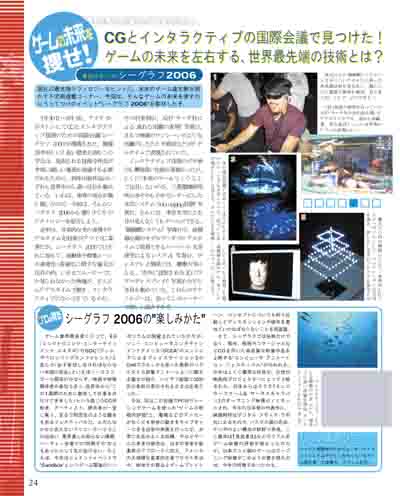
reboot me/ SIGGRAPH / weeky Famitsu


I'm sorry for my long absent...

I had back from SIGGRAPH2006 Boston.
Then I will write something about it.

Especially, I had written an article for Weekly Famitsu, a most famous weekly game magazine in Japan.
I have a small column that named as "Look for the future games!".

This article will be sold at 25th August 2006 on the store (Issue:8thSep).

20 February, 2006

"savoir plus science" our lab on the TV


Regardez "savoir plus science" le 4 février à 13h50 sur France2!
http://onvousditpourquoi.france2.fr/
Notre laboratoire a participé!
Watch a scientific TV program "savoir plus science" at 4 February, 13:50 on France2!
http://onvousditpourquoi.france2.fr/
Our laboratory has participated!

ć…ˆæ—„ćŽéŒČが無äș‹ç”‚äș†ă—ăŸăźă§ă™ăŒ、
Simonăšç ”ç©¶ćź€ăźăƒ‡ăƒąăŒăƒ†ăƒŹăƒ“ç•Ș甄にć‡șæŒ”ă—ăŸă™。
「savoir plus science」
2/4(㜟) France2 13h50-
http://onvousditpourquoi.france2.fr/

科歩ç•Ș甄です。

ć­Šç”ŸăŒăƒ‡ă‚žă‚«ăƒĄă§æ’źăŁăŸć‹•ç”»ă‚‚ă‚ă‚‹ă‚“ă§ă™ăŒ、ăŠæ„œă—ăżăŻæ”Ÿæ˜ æ™‚ă«!
…ăŸă‚ăƒ•ăƒ©ăƒłă‚čé™ćźšæƒ…ć ±ăȘんですが。

18 February, 2006

Nintendo will start movable theme park project

Nintendo will start movable theme park project of "PocketMonsters" all over the world. (Nikkei)
Nintendo will start a theme park project using PocketMonsters in limited term.
They will start in Taiwan at next June, and continue it in different country at each year until 2010.
This is the first time such as oversea project using Japanese original character.
They have plans to show movies and sell game tie-up contents to make synergy.
The movable theme park will name as "PokePark" and start in Taipei for 3 months.
Charactor coaster, wheel, 5-10 children attractions and mini theaters and interactive games will be installed.
Area will be 40,000 sqm. 1,000,000 visitors will be expected.
They also have plans to show Pockemon movies on the TV and sell their card games.
And they have plans to exhibit in USA , Europe and China-Shanghai.
Recently, they developped new theme park of Karuta, traditonal japanese card games using game technologies in Kyoto.
aki o_ob

31 January, 2006

A funny "function" of PSP

FDS:Flying Disk System. It's a "specification" of the PSP first version. You can shoot UMD when you play a game.

It also my reason why I haven't get PSP...
Today I found a funny movie about this issue.

"PSP vs NDS"
http://www.asahi-net.or.jp/~cf6y-oot/umd/fly_006.avi
The golf game said "Nice Shot!" but... :-)

You can see other movies, whew... I also found PSP playable...

"Organized site of PSP troubles"
http://www.asahi-net.or.jp/~cf6y-oot/umd/fly.html


Do you know the current PSP have this "function"? :-)

aki o_ob

HRP-2 helps human daily life with autonomous function.

My associate Mr. Moriyama wrote an issue.

"HRP-2 helps human daily life with autonomous function"
http://pc.watch.impress.co.jp/docs/2006/0131/kyokai42.htm
You can get some video from the site.

It's a pair of distributed autonomous robotic system for daily life supports.

On the press demonstration, they has composed 3D map with laser range finders.
(but it haven't written in this article.)

*If someone need detailed translation, please contact me.
http://akihiko.shirai.as/modules/contact/

Nam June Paik passed a way.

He is a father of media arts and video arts.
Great history he is! 40 years or more.

I wrote a short condolence here in Japanese.
http://ameblo.jp/akihiko/entry-10008568387.html

And I introduce you his official website.
http://www.paikstudios.com/
It was updated about funeral information.

aki o_ob

06 December, 2005

New movie from BodyPad

"Full body oriented battle interface"
BodyPad presents new promotion movie.
(Thanks Frederic Claudel!)
http://www.bodypad.com/eng/Alternative.php [English]
http://www.bodypad.com/fra/Alternative.php [Francais]

I saw "Mr.Satan" from DragonBall...
Bad boy have to do like that!(=Good boy shouldn't do like that!)

aki o_ob [article in Japanese]

23 November, 2005

CFP: 2 Human Interface and 1 encyclopedia

* The IEEE Symposium on 3D User Interfaces 2006 (March 25 and 26, Alexandria, Virginia USA, DL: November 30, 2005)
*ACM SIGCHI ACE 2006 (Hollywood U.S.A., 14th-16th, June 2006, DL: 15th Feb. 2006)
*Encyclopedia of Networked and Virtual Organizations

SIGCHI ACE is ineresting conference (I had participated at 2005). However IEEE-3DUI is also very interesting. They will be held with IEEEVR2006.
But, why the deadline is same (30th Nov)?

So, one submission has been accepted by IEEEVR2006 from my laboratory.
Congratulation, Lionel.

aki o_ob

22 November, 2005

Call for Teachers: Gifu Univ. Japan. VR Research assistant (Ph.D)

Call for Teachers: Gifu Univ. Japan. VR Research assistant (Ph.D)
Deadline has extended.
I think this is good post. Because Gifu Univ, VR Lab is great laboratory and investiment is not bad, I guess.
"30 years or less" + "Doctor" is little difficult?

---Japanese below---
ćČé˜œć€§ć­Šć·„ć­Šéƒšäșșé–“æƒ…ć ±ă‚·ă‚čăƒ†ăƒ ć·„ć­Šç§‘æ•™ć“Ąć…Źć‹Ÿ(ćżœć‹Ÿç· ćˆ‡ć€‰æ›Ž)

.拟集äșș擡 ćŠ©æ‰‹ ïŒ‘ć
.所  汞 äșșé–“æƒ…ć ±ă‚·ă‚čăƒ†ăƒ ć·„ć­Šç§‘çŸ„èƒœćˆ¶ćŸĄă‚·ă‚čăƒ†ăƒ ć·„ć­ŠèŹ›ćș§
.氂門戆野 ロボティクă‚č,ăƒăƒŒăƒăƒŁăƒ«ăƒȘケăƒȘティ,ćˆ¶ćŸĄć·„ć­Šăźćˆ†é‡Ž
.着任時期 ćčłæˆïŒ‘8ćčŽ4月旄
.ćżœć‹Ÿèł‡æ Œ
 (1)ćšćŁ«ăźć­Šäœă‚’æœ‰ă™ă‚‹ă“ăš,ă‚‚ă—ăăŻć–ćŸ—ăźèŠ‹èŸŒăżăŒă‚ă‚‹ă“ăš
 (2)ć­Šç”Ÿăźæ•™è‚Čă«æ„æŹČがあるこべ
 (3)ç†è«–ăšćźŸéš“ă«ć–ă‚Šç”„ă‚ă‚‹æ–č
 (4)ćčŽéœąăŻ30æ­łăŸă§ăŒæœ›ăŸă—ă„
.ćżœć‹Ÿç· ćˆ‡ ćčłæˆ18ćčŽ1月10æ—„(金)濅着(æłšæ„:1月20æ—„(金)ă‚ˆă‚Šć€‰æ›Ž)
.ćżœć‹Ÿæ›žéĄž
 (1)ć±„æ­Žæ›ž(ć†™çœŸæ·»ä»˜,ăƒŻăƒŒăƒ—ăƒ­ćŻ)
 (2)研究愭瞟䞀芧(ć­ŠèĄ“è«–æ–‡,ć›œéš›äŒšè­°è«–æ–‡,著曞,ç‰čèš±,è§ŁèȘŹă«ćˆ†éĄž,
    ć…±ćŒç ”ç©¶ă‚„ç ”ç©¶ćŠ©æˆé‡‘ç­‰ăźć–ćŸ—çŠ¶æł,ć­Šć”äŒšăźćœč擡・ć§”ć“Ąç­‰ăźç€ŸäŒšèȱ猼)
 (3)䞻芁論文3ä»¶çš‹ăźćˆ„ćˆ·ă‚‚ă—ăăŻă‚łăƒ”ăƒŒ
 (4)ç ”ç©¶ăźæŠ‚èŠăšä»ŠćŸŒăźç ”ç©¶æ§‹æƒł(2000歗繋ćșŠ)
 (5)教è‚Čă«ćŻŸă™ă‚‹æŠ±èČ (1000歗繋ćșŠ)
 (6)掚薊状

.遞考æ–čæł•  æ›žéĄžă§äș‹ć‰éžè€ƒă—,æœ€ç”‚çš„ă«ăŻéąæŽ„ă«ă‚ˆă‚Šéžè€ƒă—ăŸă™.
.æ›žéĄžæć‡ș慈

  〒501-1193 ćČé˜œćž‚æŸłæˆž1ç•Ș1 
  ćČé˜œć€§ć­Šć·„ć­Šéƒšäșșé–“æƒ…ć ±ă‚·ă‚čăƒ†ăƒ ć·„ć­Šç§‘ ć­Šç§‘é•· è°· ć’Œç”·
  Tel : 058-293-2783, E-mail: tani(at)info.gifu-u.ac.jp
  「æ•™ć“Ąćżœć‹Ÿæ›žéĄžćœšäž­」ăšæœ±æ›žăă—,ç°Ąæ˜“æ›žç•™ă§éƒ”é€ă—ăŠäž‹ă•ă„.

10.敏搈せ慈
  〒501-1193 ćČé˜œćž‚æŸłæˆž1ç•Ș1 
  ćČé˜œć€§ć­Šć·„ć­Šéƒšäșșé–“æƒ…ć ±ă‚·ă‚čăƒ†ăƒ ć·„ć­Šç§‘ ć·ćŽŽæ™Žäč…
  Tel & Fax: 058-293-2546, E-mail: h_kawasa(at)cc.gifu-u.ac.jp
---
If you cannot read Japanese, this post is very difficult, I think. :-(

aki o_ob

Triple call for papers

-WIAMIS06 (April 19th-21st, 2006, Hyatt Regency Incheon, KOREA, DL:Nov 30,
2005)
Workshop on Image Analysis for Multimedia Interactive Services (WIAMIS 06)
April 19-21, 2006 Hyatt Regency Incheon, KOREA

-Workshop CHI'06 (22,23th April 2006, Montreal, Canada, Deadline: 19 Dec
2005)
"Information Visualization and Interaction Techniques for Collaboration
across Multiple Displays" CALL FOR WORKSHOP PAPERS CHI2006 International
Conference

-Edutainment 2006 Conference on E-learning and Games (Deadline extended to
NOV 30)
Web site: http://www.cad.zju.edu.cn/vrmm/edutainment/ Submission
Mailbox:Edutainment06(at)cad.zju.edu.cn

Details are archived here.
http://akihiko.shirai.as/modules/bwiki/index.php?CallForPapers

So, why such as same topic conferences make same deadlines...
I have interests for all.. probably CHI Canada is best for me.
However, if I submit my research result now, who will pay for me...?
Of course, it's a sort of brake of research but sometime it makes troubles...
(My grant patron will be change at Jan.)

aki o_ob

21 November, 2005

CFT: The Technische Universiteit Eindhoven

Call For Teachers
---
The Technische Universiteit Eindhoven (TU/e) has the following vacancy PhD position on QUASID: Quantitative Spatial Interaction Design (V51.015)
at the User-Centered Engineering group, Department of Industrial Design.
The TU/e department of Industrial Design applies a unique, innovative
education model of competence-based learning, in which a professional
design environment is simulated. Apart from the central focus on design,
various areas of technology are an integral part of the curriculum.
These areas are: mechanical engineering, electrical engineering,
computer science, technology management and user-centred engineering.
Man as user is the starting point for any design activities. Our
Bachelor programme started in September 2001. Industrial Design is
building a research programme focused on the relationship between users
on the one hand and future intelligent products, systems and services on
the other. The main fields of research are 'Designed Intelligence' and
'User Centred Engineering'. In short, TU/e Industrial Design department
distinguishes itself through its unique education model, ambitious
research goals and an excellent working environment and atmosphere.
The research in the User-Centered Engineering group focuses on advanced
interaction concepts and user-centered design methodology. It takes a
constructive approach ("research through design"). The aim is to develop
interfaces that support natural interaction, both in the context of
single-user single-system interaction and multi-user multi-system
interaction and their cross-combinations. Main research questions are
what constitutes natural interaction and how it can be realized. Topics
that are addressed are multimodal interaction, perceptive interfaces and
aware environments. The research focuses both on developing new
interaction concepts and implementing them in prototypes, as well as the
connected design and evaluation methodology.
The project: QUASID: Quantitative Spatial Interaction Design - Tasks
and Metrics for Spatial Interaction
Although the experimental validation of spatial interaction techniques
is gaining interest internationally, many virtual reality researchers
still consider it an 'art' rather than a 'science'. In the design cycle
of spatial interaction techniques, which contains phases of concept
formulation, implementation and evaluation, the evaluation part is most
often addressed in a qualitative way, rather than being based on firm
quantitative evidence. In those cases where evaluation of spatial
interaction techniques is performed, the experimental set-up is usually
derived from ad-hoc assumptions about the relevance of the task, the
environment and other conditions that have an effect on the outcome.
This Ph.D. project is part of a multi-disciplinary project, called
QUASID, that consists of three related Ph.D. (sub)projects. The overall
project has two main objectives. First, to develop a more quantitative
approach to the design of spatial interaction techniques. Second, to
apply and test this quantitative approach in the design of new spatial
interaction techniques for mixed-reality desktop environments. The
proposed project therefore combines research at three complementary
levels:
1. at the methodological level, by developing classifications and
metrics that can be used in the
evaluation of spatial interaction techniques for desktop mixed-reality
environments (main focus of this Ph.D. project),
2. at the device level, by developing robust and effective methods for
creating tangible interfaces, and by evaluating the effect of the
physical shape of interaction devices on interaction efficiency and
effectiveness,
3. at the system level, by studying the usability of tangible interfaces
that are based on both (fully) manual and semi-automated spatial
interactions.
The latter two sub-projects have already been filled in.
Tasks
The QUASID project is multi-disciplinary, in the sense that both a
technology-oriented (computer science) and a user-oriented (human
factors) perspective are represented. More specifically, the goals of
this Ph.D. (sub)project are threefold:
1. To develop a taxonomy (i.e., a formal categorization) for spatial
interaction techniques in desktop mixed-reality environments. The
taxonomy will structure generic tasks, such as selection and
positioning, as well as more composite and specific tasks, such as
pursuit tracking and tracing.
2. To develop metrics, in addition to Fitts' law (i.e., time and
accuracy), that can be used as dependent variables to quantify
interaction. The specific goal is to explore new perceptual and
cognitive criteria for evaluating interaction, based on an existing
expertise in quantifying aspects such as coordination and subjective
judgements.
3. To develop a test-bed based on the taxonomy and the developed
metrics. The test-bed will be used to collect and document experimental
data, including all independent variables, such as relevant system,
user, and environment aspects, and dependent variables, such as
efficiency, effectiveness and appreciation parameters. Experiments on a
number of diverse systems will be conducted in order to verify the
validity and reliability of the test-bed methods.
The Ph.D. student will conduct his/her research project within the
J.F.Schouten School for User-System Interaction Research (see
http://fp.tm.tue.nl/jfschouten for more information). This project is
sponsored by NWO (Dutch National Science Foundation). The Ph.D. student
will be required to closely co-operate with the other two Ph.D. students
within the QUASID project.
Requirements
The candidate should have a MSc degree in one of the following areas:
human-system interaction, computer science, electrical engineering or
industrial design. He/she should be interested in both virtual/augmented
reality and experimental research, and able to co-operate in a
multidisciplinary team.
Appointment and Salary
We offer a position for a period of 4 years. PhD students will receive a
monthly salary of 1.813,00 euro in their first year, which will rise to
2.394 euro (gross) in the final (fourth) year. Eindhoven University of
Technology has an excellent package of attractive benefits for
employees, a child-care facility, and a modern sports complex.
Information
More information can be obtained from:
- about the position (including an extended project description):
Prof.dr.ir. Jean-Bernard Martens, phone +31 (0)40 247 5208; e-mail:
j.b.o.s.martens at tue.nl;
- further information: Ms. Julma Braat, personnel assistant, phone +31
(0)40 247 5883, e-mail: j.a.c.l.braat at tue.nl
Application
Please send a written application, including a letter explaining your
specific interest in the project and extensive curriculum vitae, to the
following address, mentioning the vacancy code V51.015:
Technische Universiteit Eindhoven
Department of Industrial Design
Attn. Ms. J. Braat, room HG 3.92
P.O. Box 513
5600 MB Eindhoven
The Netherlands
E-mail: j.a.c.l.braat(a)tue.nl
Job applications can be submitted until December 23, 2005, but will be
processed on a first-come-first-serve basis (i.e., the first suitable
candidate will be selected).

Tomoe Shinohara revival in Paris

The time difference between Japan and France is 8 hours in official. However "the time difference of pop culture" is about 6-8 years in my experience, I guess.

I can say "trop tard"(too late) in bad language, bat we can see the future in France opposite. Additionally, someone who are alredy tired in Japan may get popularity in France. Then loser is Japanese who are alredy developed but not rewarded from the other's point of view.

For example, in France, I saw a TV program "DOMINO DAY" at the last weekend. But this type of TV events are almost tired in Japan at 1999 or before. Of course I can find a lot of "french decoration" in the TV program. However, in fact, my works are such as "redevelopment and exporting for computer entertainment" then I can enjoy to see when such as "burned pop culture" be revival in France.

Today, I found same example in pop music, "Tomoe Shinohara".
She is a famous pop and techno music singer, artist and designer about 1996-1999. But she got a great chance in Paris last week.


"Parisien has tranced with Tomoe SHINOHARA in JPOP Festa."
http://headlines.yahoo.co.jp/hl?a=20051121-00000030-sanspo-ent
"Tomoe SHINOHARA will participate to Paris music festibal, break in France"
http://headlines.yahoo.co.jp/hl?a=20051121-00000011-sph-ent

Too large story, they are! She just sing once time? But I think "Ultra-Relax" is her best song in her golden age, and her strange Japanese language is sounds good for French "otaku" Japanese speakers (she speaks crasy funny Japanese with hiragana and katakana). Of course, it is not a traditional Japanese, I can say.
Especially, such as funny news relax me because recently Japanese journal say "France = Violence". And "fĂȘte de music a Paris" is great chance for her. Please sing in French, svp!


So, I haven't know, her latest song, "Aso-Fever" has used to the latest ending theme song of "Gashbell(Zatchbell)", I think if Zatchbell also will be fever if the TV program statrted. But... it is little difficult to get social assumption because of they describe themselves as "battle action anime"...


I found some interesting websites about this topic below.

Multilingual funsite of Tomoe SHINOHARA
http://www.tsforever.com/
Article,
http://www.orient-extreme.net/index.php?menu=musique&sub=actu&article=60
with this whitemen dance performance.
http://www.yamatonatto.com/
In such as online store,
http://www.kogaru.net/
Here also.
http://www.webotaku.com/pages/japon/news.php?id_news=5476

This is an official page of Tomoe SHINOHARA.
http://www.takeitag.co.jp/tomoe/

So, can I call her to fete de music Laval for 2007, because she is also curator of Digital Studium(NHK)...

aki o_ob

Maywadenki "Ko-in-ten"


Maywadenki(Meiwa-denki) is a world famous media artist unit that has concept of Japanese electronic small company + acoustic instrument + media arts.
Their ko-in (factory worker, operative, artisan and artist in fact) will be held their exhibition in Yokohama.

Maywadenki "Ko-in-ten"
Nov. 8th - 20th, 2005. 11:30~19:30
Yokohama Garou Garou
http://www.garougarou.com/

Official Homepage of Maywadenki (no articles about this exhibition at Nov 21st)
http://www.maywadenki.com/

20 November, 2005

modulobe, real time artificial life project


I had found interesting project, "modulobe" by Prof. Koichiro Eto, when I seek current real time physics simulator states.


Our Springhead also support such as artificial life but looks cool.

They have website, wiki and community on mixi.
And they are exhibiting at NTT ICC museum until 25th December.
(and ICC will be shut soon!)
http://www.modulobe.com/
When register your character file to their wiki, you can see them on ICC!

aki o_ob

18 November, 2005

Dancing 50 hours on a wall with new Walkman

"Dancing 50 hours on a wall with new Walkman"
FujiSankei Business i. 2005/11/18

Sony released a new music player "Walkman A" at 19th November, then they start a promotion performance that installs dancers on a wall of Shibuya Station and they dance during 50 hours.

This promotion focuses to the stamina of new "Walkman A" that can play during 50 hours or more. Total 50 dancers are prepared and each dancer changes every 30 minutes.


If the producer could find other specification on the new walkman, he will not do such as stupid advertise. Because, I cannot see the new walkman on the picture!!
So, I hope no dancers will dies or catch a cold in this event...too cold, isn't it?

aki o_ob